
Key takeaways
BrandAxis shows whether AI models mention your business, how they describe it, which competitors appear, and which sources influence the answer.
The competitor, prompt and source data can reveal where a business needs stronger content, authority and positioning.
The free tier gives teams a low-risk way to test real customer prompts before deciding whether broader tracking is worth paying for.
Table of contents
- Search has changed, even if your SEO dashboard has not
- What BrandAxis actually does
- How BrandAxis looks in practice
- The information that changes the business conversation
- What I learned from testing BrandAxis
- Why a zero or low score can still be valuable
- Who should be using an AI visibility tool
- Starting for free
- Turning visibility data into action
- What is coming next on the BrandAxis roadmap
- Final verdict
Search has changed, even if your SEO dashboard has not
For years, businesses have used Google rankings, organic traffic, backlinks and keyword positions to judge their online visibility. Those metrics still matter. But they no longer tell the whole story.
Customers are now asking AI tools direct, decision-led questions: Who is the best provider in my area? Which company has the strongest reviews? Who offers this service at a reasonable price? What should I compare before choosing?
When ChatGPT, Perplexity, Claude, Gemini, Copilot, Grok or Google's AI experiences answer those questions, they may recommend a handful of businesses without the customer ever reaching a traditional search results page.
That raises a new visibility question for every business: Are AI tools mentioning your brand, describing it accurately, and citing sources that support your credibility?
This is why AI visibility tracking is becoming a must-have layer alongside traditional SEO.
What BrandAxis actually does
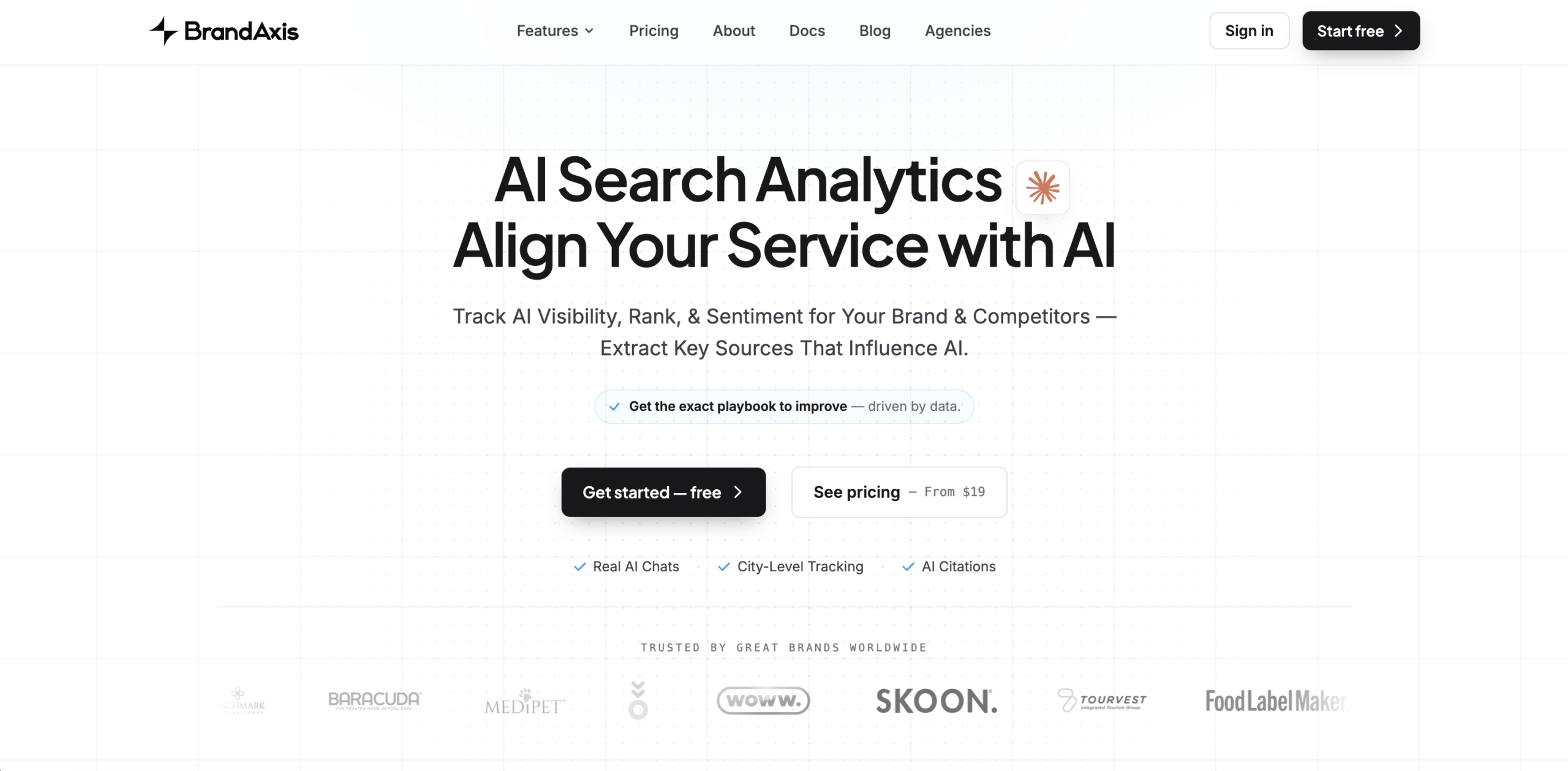
BrandAxis is an AI visibility platform that helps businesses understand how their brand appears across supported AI models. Instead of relying on a vague sense that AI search is important, it gives marketers and business owners a workspace where they can test the prompts customers are likely to ask and monitor the answers.
At a practical level, BrandAxis helps you investigate:
- Whether your brand is mentioned for important customer prompts.
- Where your brand ranks when it is included in an answer.
- Whether the surrounding description is positive, neutral or potentially concerning.
- Which competitors are being recommended instead.
- Which websites, directories, publications and user-generated sources are shaping the answer.
- How visibility differs between supported AI models and over time.
That combination matters because a visibility score on its own is not enough. A business needs context: what the score means, why a competitor is winning, and what can be improved.
How BrandAxis looks in practice
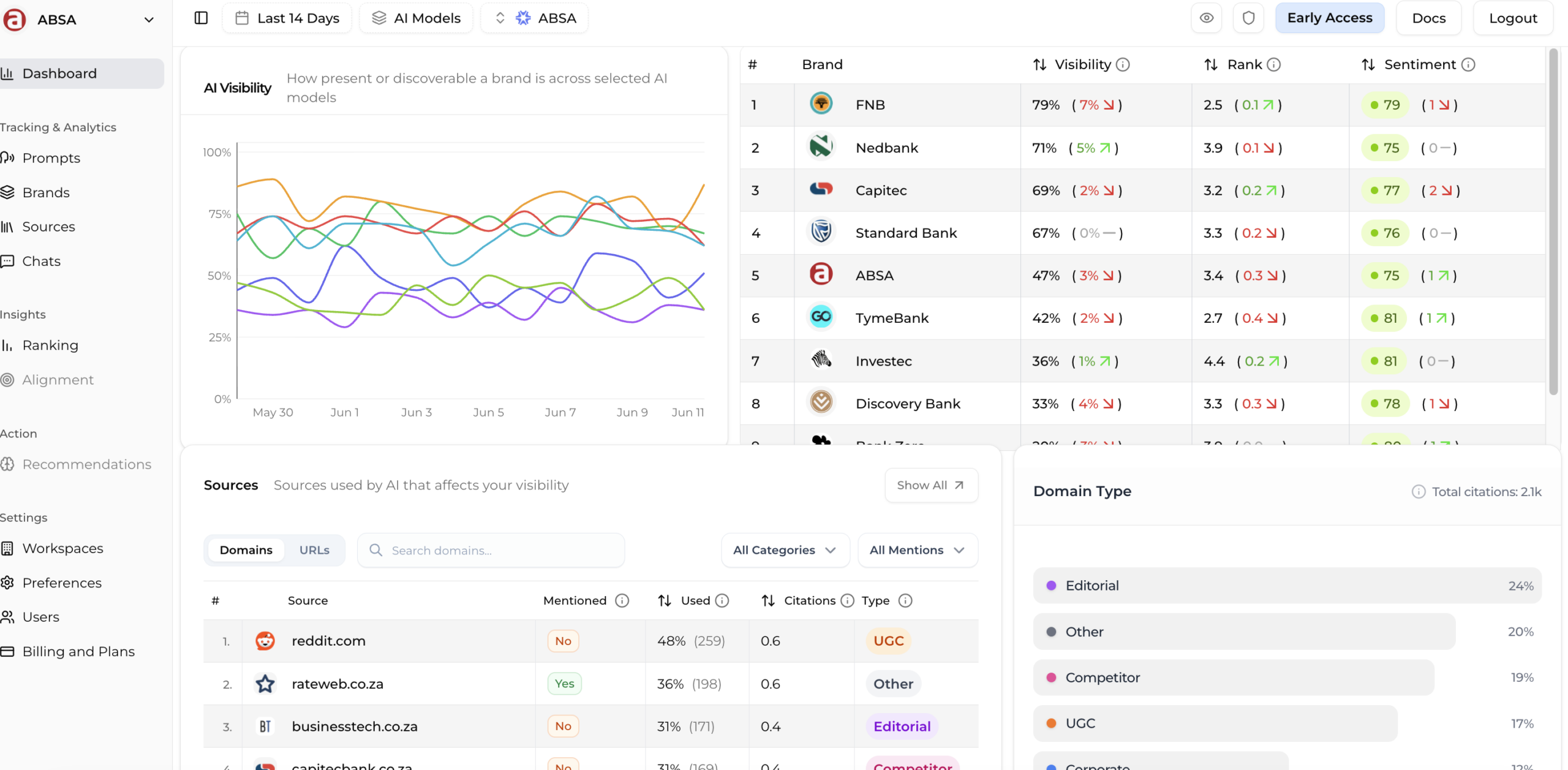
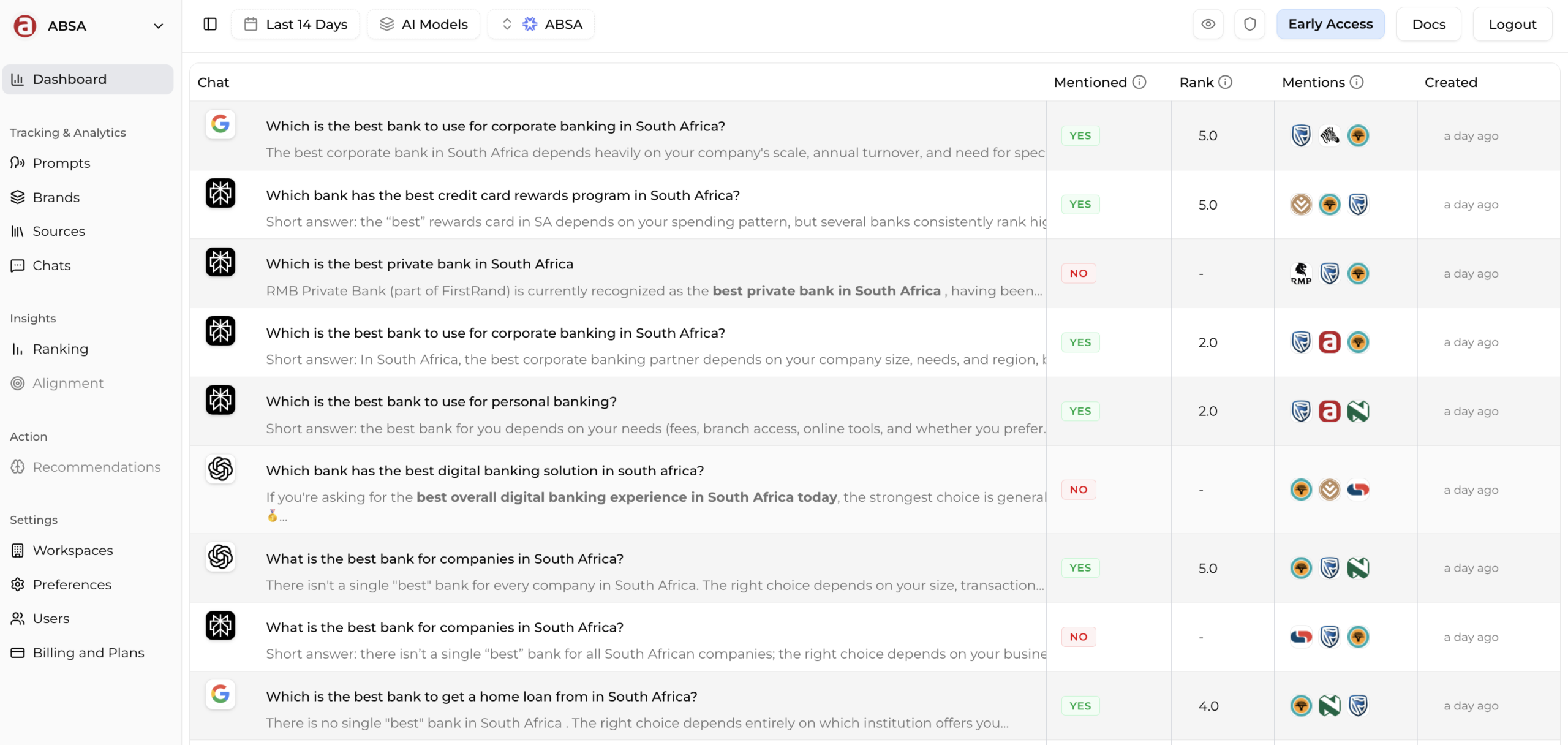
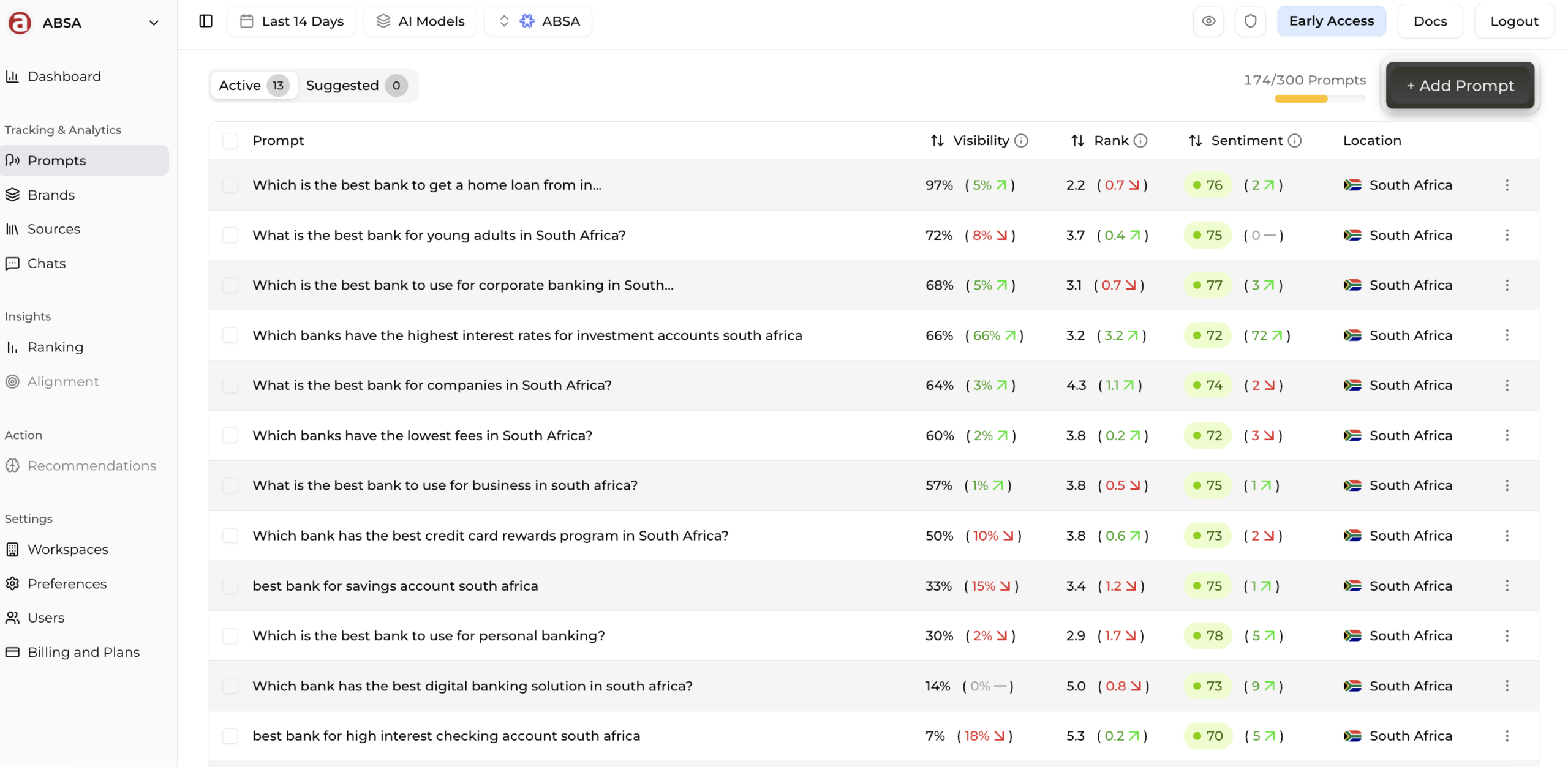
The product is easier to understand once you see the workflow. BrandAxis is not just reporting a single AI visibility number. It is bringing together prompts, model results, competitors, sentiment and sources in one place.
The information that changes the business conversation
Brand and competitor visibility
BrandAxis can show whether a business appears for the questions that matter commercially, not only whether its website ranks for a related keyword. A company may have a solid Google presence and still be absent when an AI model creates a shortlist.
Prompt-level insights
The prompts view helps businesses move beyond broad vanity metrics. A brand might be visible for one specialised service but invisible for general category, affordability, review or location-based questions. That gives the marketing team a much clearer content brief.
Sources and citations
The source data is one of the most useful parts of the platform. It reveals the domains that AI systems draw from when producing answers in a category. These may include competitor websites, directories, editorial articles, reviews and community platforms.
For a business, this turns AI visibility from an abstract concept into an authority plan: improve the pages you control, strengthen third-party trust signals and understand where your competitors are earning credibility.
Sentiment and brand description
Being mentioned is not automatically a win. The language surrounding the mention matters too. BrandAxis helps teams see whether the brand is positioned positively, neutrally or inaccurately, and whether that narrative shifts between models.
What I learned from testing BrandAxis
I started by testing DigiBee, a very new business with limited brand history. The initial visibility result was naturally low. But the platform was still useful because it showed which competitors and sources were already shaping answers around SEO, digital marketing and AI visibility in South Africa - specifically for me.
That was the first important lesson: the value is not limited to seeing your own brand name on a dashboard. Even when your visibility is low, the surrounding ecosystem shows you what the market and the models currently trust.
I then tested an established local-service client using five high-intent prompts. The overall visibility was modest, but one specialised service stood out with first-position visibility and positive sentiment. The other prompts showed clear gaps.
That result was immediately actionable. It showed what the client was already known for, which strength should be protected, and which service pages, review signals and third-party sources needed more work.
BrandAxis did not simply provide a score. It helped turn AI search into a practical marketing conversation.
Why a zero or low score can still be valuable
A business owner may see a low visibility score and assume the tool has nothing useful to say. In practice, that can be where the most valuable work begins.
- The prompts reveal where the brand is absent from real buying conversations.
- Competitor results show who AI models currently recognise in the category.
- Source data points to the websites and credibility signals influencing those answers.
- Model differences show where the brand narrative is strong, weak or inconsistent.
- Repeated tracking creates a baseline that can be measured after content and authority improvements.
For a new brand, the question is not, "Why am I not famous yet?" It is, "What would make my business easier for AI systems and customers to understand and trust?"
Who should be using an AI visibility tool
BrandAxis is particularly relevant for businesses where customers research, compare or shortlist providers before making contact.
- Local service businesses competing for recommendation-style searches.
- Professional firms whose reputation and expertise influence buying decisions.
- Ecommerce brands that need products to appear in comparisons and recommendations.
- B2B companies with longer research and evaluation journeys.
- Marketing teams that need to compare brand positioning across AI models.
- SEO consultants and agencies that want to add AI visibility to audits and reporting.
For these businesses, AI visibility tracking is becoming similar to rank tracking: not the entire strategy, but an increasingly important measurement layer.
Starting for free
The easiest way to understand AI visibility is to test it with your own business. BrandAxis offers a free starting tier, allowing you to create a workspace and begin monitoring a focused set of prompts before committing to a paid plan.
Choose prompts that sound like real customer questions. Do not include your own brand or competitor names. Focus on category, location, affordability, reviews, service type and the problem the customer wants solved.
For example:
- Who are the best [service providers] in [city]?
- Which [type of company] has the best reviews in [location]?
- Who can help my business with [specific problem]?
- What is the most affordable reliable [service] in [city]?
- Who offers [specialised service] in South Africa?
Early-access limits and features may change, so check the current plan details before publishing.
Turning visibility data into action
No analytics platform creates visibility by itself. The value comes from what the business does with the findings.
- Strengthen service pages for prompts where the brand is missing.
- Create content that answers the comparison and decision questions customers ask.
- Improve reviews, testimonials, case studies and consistent business information.
- Build relevant mentions through directories, partnerships, editorial coverage and community participation.
- Correct unclear or outdated brand information on owned and third-party sources.
- Track the same prompt set over time to measure whether visibility improves.
This is also where a business may need strategic help. The platform identifies the visibility pattern; an SEO and AI visibility specialist translates that pattern into content, technical improvements and authority-building priorities.
Related DigiBee guide: SEO vs AI Search: What South African Businesses Need to Know
What is coming next on the BrandAxis roadmap
BrandAxis is also actively developing the platform, which matters because AI visibility is still a fast-moving space. According to Felix, the roadmap includes Brand Alignment Measurement, Hallucination Detection and Optimization Recommendations.
Measure whether AI systems describe the brand in a way that matches its real positioning, services and value proposition.
Flag invented, outdated or inaccurate brand details before they influence a customer's decision.
Turn visibility patterns into practical next steps for content, citations, source coverage and authority building.
That matters because the real value is not only knowing whether a brand is visible. It is understanding whether AI systems describe the brand correctly, whether they invent or distort important details, and what practical improvements could help the brand become easier to understand and recommend.
For me, that makes BrandAxis feel less like a one-off dashboard and more like an operating layer for how businesses manage their AI presence over time.
Final verdict
BrandAxis arrives at the right moment. Businesses are already being described, compared and recommended by AI systems, but many have no way of seeing those conversations or measuring whether they are present.
The platform makes that emerging channel easier to understand. It gives businesses a starting point, gives marketers evidence, and gives agencies a clearer way to explain where a brand is winning or missing.
For any business that depends on being discovered and trusted online, AI visibility should no longer be treated as a future concern. It belongs in the visibility toolkit now.
BrandAxis makes it possible to start exploring that visibility without paying upfront, which removes the biggest excuse for ignoring it.